
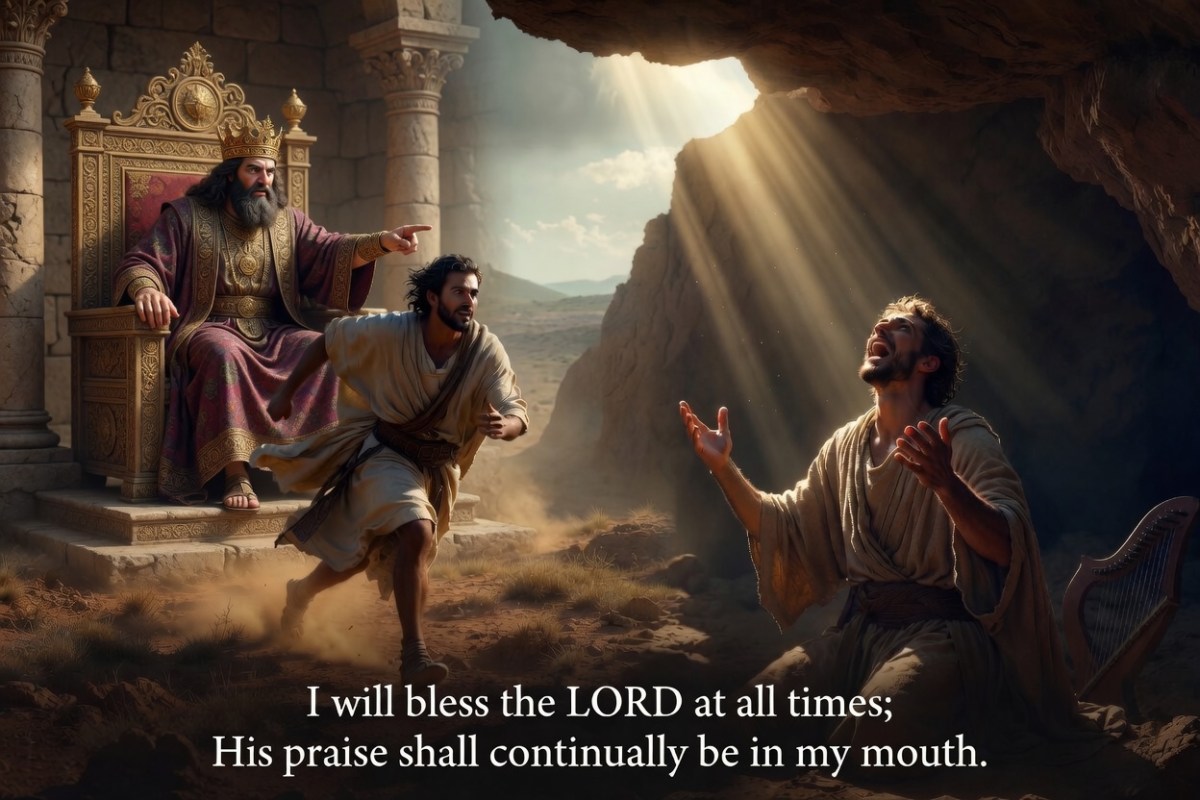
A beautiful cathedral, musicians holding fine-tuned instruments, choir director ready to lead the church into congregational worship – these are some of the images that come to mind when we think about praising God. We’ve become so accustomed to attributing praise to Sunday morning church services. We usually think about praise when everything in life feels in sync. But psalmist David gives us a different picture of praise in Psalm 34.
Psalm 34:1 -I will bless the Lord at all times; His praise shall continually be in my mouth
All-Time Praise.
That word all is easy to read and ignore, but it actually changes our perspective. It doesn’t mean most times. It doesn’t mean when life makes sense. It doesn’t mean when prayers are being answered the way we hoped. It means all phases of life.
And when David wrote that, life was not steady for him.
The title tells us: David was pretending to be insane in front of a king named Abimelech. 1 Samuel chapter 21 gives us the full picture — David was running from Saul, out of options, and somehow ended up in Gath. Gath is Goliath’s hometown. Enemy territory. He stood before the Philistine king, and when the servants started whispering that this was the same David — the one who killed their champion Goliath — he panicked. So he drooled on himself. Scratched at the gate. Acted so unhinged that the king had him thrown out.
There’s also a small detail tucked in there — the psalm calls the king Abimelech, but 1 Samuel chapter 21 calls him Achish. That is because”Abimelech” was a Philistine royal title, the similar to “Pharaoh.” So David stood infront of royalty and he walked away looking like a fool.
It is at that scary, confused, lost moment of life – somewhere in between sprinting away from a foreign court, and hiding in the Cave of Adullam (Chapter 22) – that’s when he sat down and wrote this song of praise.
Purposeful Praise
Psalm 34 is written in a special style known as acrostic poetry. In Hebrew, nearly every line starts with the next letter of the alphabet — all twenty-two, straight through from Aleph to Taw. Their A to Z. That’s not a coincidence. David was being deliberate. He was saying: from the first letter of language to the last, there is no place in the alphabet — no season in life — where praise doesn’t belong.
The Hebrew word for “bless” here is barak — and it literally means to kneel. David had just barely crawled out of a foreign king’s court. But his heart was still on its knees before the only King that actually mattered.
Our Story -Twenty-Six Years of “All Times”
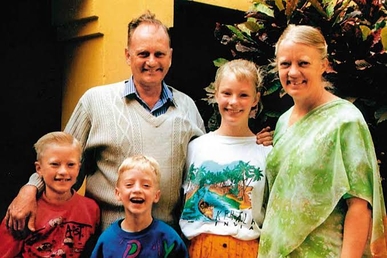
This week marks twenty-six years of marriage for my wife and I. And we can testify that not all years fit into the beautiful cathedral type of praise moments. They are indeed filled with its ups and downs.
There were eight years of waiting — years of crying out to God for a child. Those years include pregnancy losses, heartbreaks and tears. Then we were blessed with our first miracle child.
There were years where we both had jobs and there were six years with just one income.
There was the miracle of the birth of our twins when doctors had said otherwise. There was a terrifying moment during that delivery when my wife’s heart flatlined for twelve seconds, and the God who holds life in His hands brought her back.
And there were nine years of watching our oldest daughter, Hannah, face a health condition that reduced her blood platelets, until June of 2024, when she went home to be with the Lord at the tender age of sixteen.
Twenty-six years. Eight years of childlessness. Six years without a steady paycheck. Nine years of battling a disease along with our daughter. Passing of our dear Hannah. Miracles and losses. Mountaintop blessings. Valleys we did not expect and did not choose.
And if we are honest, we cannot say that we praised God perfectly through every moment of it.
There were seasons of strong faith and seasons of utter exhaustion. Moments when worship came easily, and moments when all we had were tears and unanswered questions.
Yet through every season, God remained faithful.
And perhaps that is part of what David meant in Psalm 34 when he declared, “I will bless the Lord at all times.” Not that every moment felt triumphant, but that even through weakness, grief, fear, and struggle, God’s grace continued to carry our hearts back to Him.
What “All Times” Looks Like in Practice?
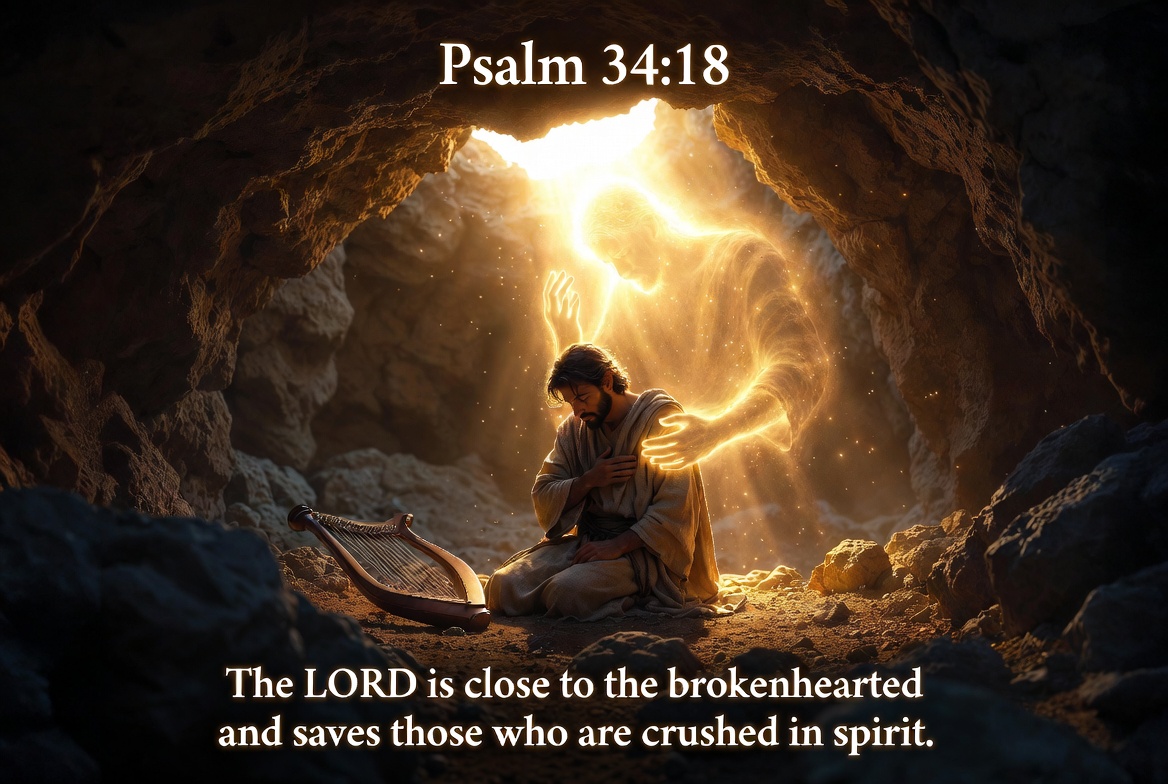
David writes in verse 18: “The Lord is near to the brokenhearted and saves those who are crushed in spirit.” The Hebrew word for “brokenhearted” is shabar — it means shattered, burst, broken into pieces. The Hebrew for “crushed in spirit” describes something beaten completely flat. David was not writing poetry about people who were mildly inconvenienced. He was writing as one who had nothing left. But even then David says: “His praise shall continually be in my mouth.”
David did not pretend the cave wasn’t dark. He did not post smiling pictures while going through pain. He’s telling us that he tasted the bitterness — and still chose to bless the Lord. The word continually in Hebrew suggests something without interruption, like a river that keeps flowing. This praise did not include his harp and musical instruments. All he had in the cave was a heart that was broken, but still willing to worship God despite his circumstances.
Life Application
If you are in a season that feels more like a cave than a cathedral, you are in exactly the right place for Psalm 34. You do not need to have it all together to praise God. You do not need to understand the season to bless Him in it. David did not praise from a throne — he praised from a fugitive’s hideout. And God heard every word.
Twenty-six years have taught us this: the goodness of God does not leave us abandoned in our hardest chapters. If anything, it is in those chapters that we have felt it most. Not always as answers, but always as enough peace and Presence of God for the moment.
So today, whether your home is full of joy or full of grief, whether this year has brought a miracle or a mystery — choose to bless the Lord. From the first letter of your story to the very last. He is worthy of it all, at all times – in the cathedral and the cave










 Dew Drops of Manna
Leave a comment