
Gethsemane- He Gets Us

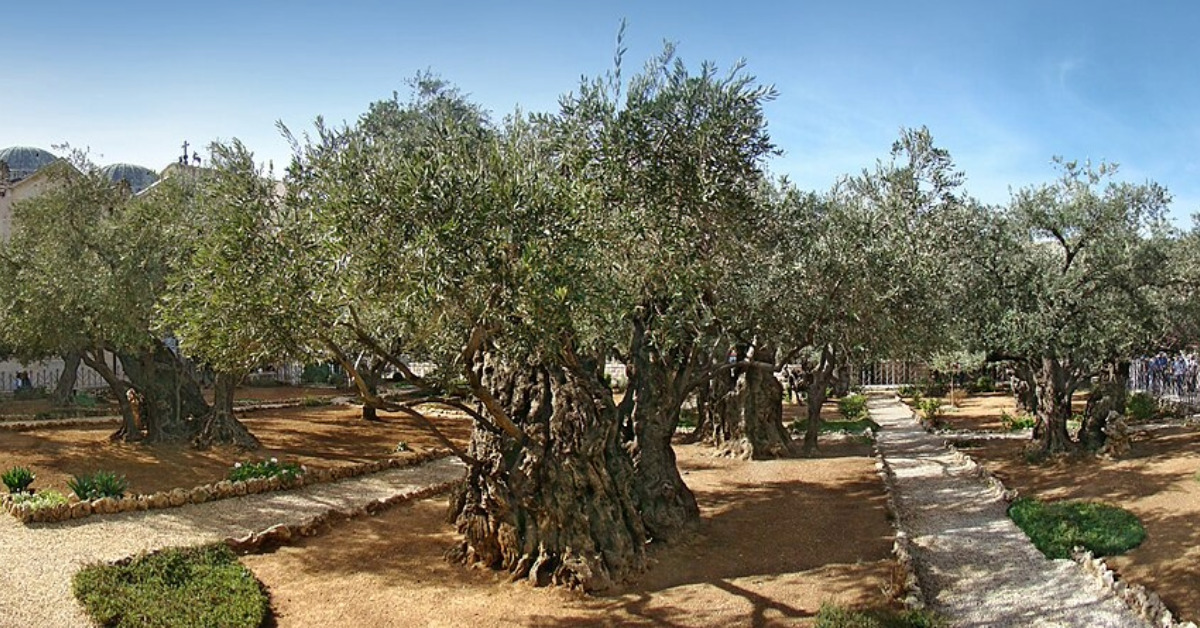
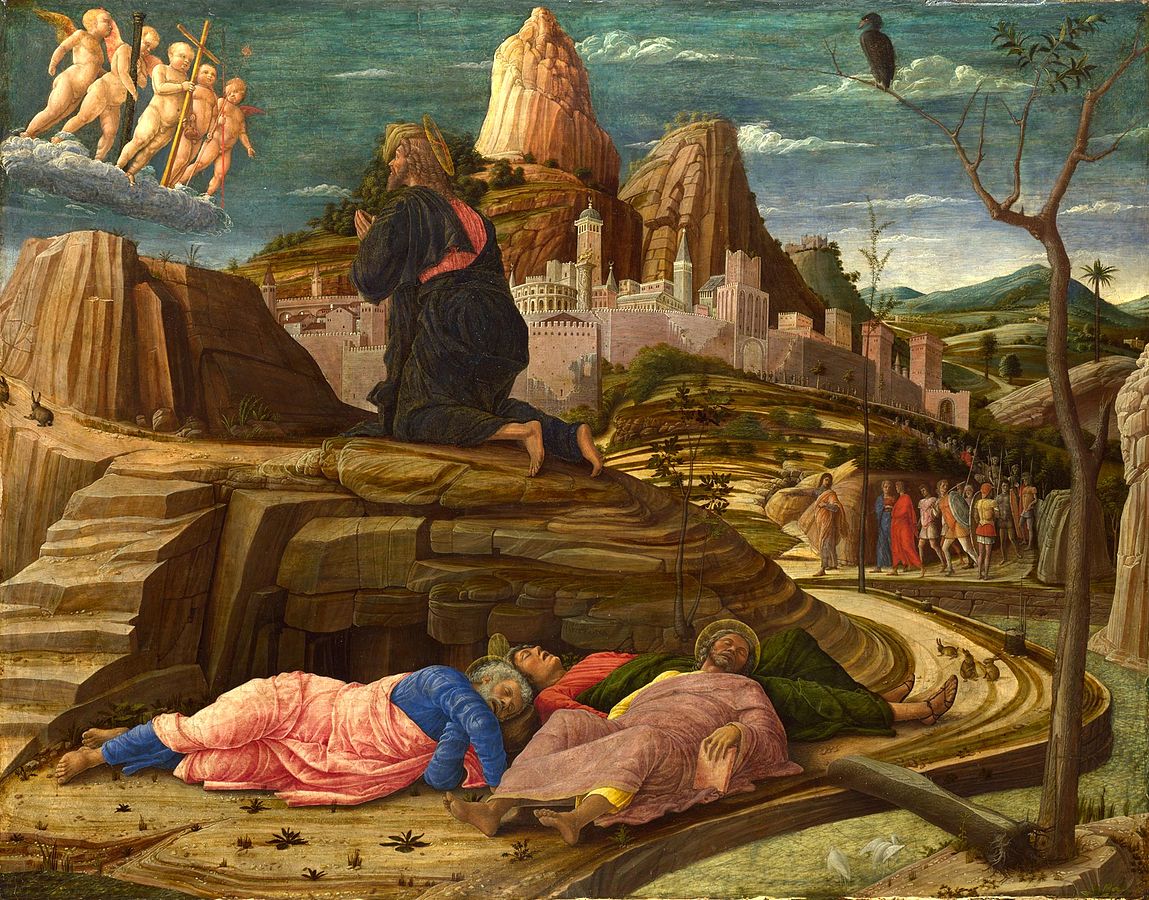
Everyone loves beautiful gardens, and botanical gardens proudly welcome a staggering 4 million visitors each year. The sheer beauty and awe that these splendid creations evoke captivate our minds as we stroll through these landscapes. However, there’s one garden of profound importance, that surpasses them all in significance—the Garden of Gethsemane.

Mark 14:32-36 – And they went to a place called Gethsemane. And he said to his disciples, “Sit here while I pray.”… and began to be greatly distressed and troubled. And going a little farther, he fell on the ground and prayed that, if it were possible, the hour might pass from him.  And he said, Abba, Father, …Remove this cup from me. Yet not what I will, but what you will.”

Gethsemane: The Olive Oil Press
Hebrew word for Gethsemane is GatSh’manim. This comes from two words: gath, which means the press; shmanin, is the word for olives. Olive oil played a crucial role, from being used in everyday lampstands to serving in ceremonial cleansing by priests.

Farmers used sticks to knock olives from trees. The olive press involves two stones, one large atop and another beneath, effectively crushing the olives to extract oil. Alternatively, men could also press olives underfoot to obtain the desired olive oil.

This holds great significance as it symbolizes Jesus undergoing beating, crushing, and piercing for our redemption. Let’s look at some things that happened at this Garden.

Garden of Agony
Gethsemane was indeed a garden where Jesus went through deep agony. Here he was:

  • Pressed, Tempted, Surrendered. As Jesus prayed, his sweat resembled blood drops. Tempted like any other man, he implored the Father to spare him from the impending death, but submitted to the Father’s will. Mark Chapter 14 depicts this distressing moment as a moment when He was deeply troubled and He fell to the ground. Notice that the reason for this agony stemmed from the realization that, for the first time, He would be separated from the Father, and it was not an attempt to evade His mission.
  • Pressed and Punished. Equally important is the fact that the reason for his agony was that the cross was going to be the full unleashing of the wrath of God the Father, and the sin of the whole world was going to be laid upon the sinless Son of God. That includes our sins, and the sin of generations past, present and future.

Garden of Betrayal
Gethsemane showed the deepest betrayal. Jesus spent three and a half years with 12 disciples, loving and teaching them about God’s mysteries. But when He needed help, no one was there. Judas Iscariot betrayed Him, and even His trusted friends—Peter, James, and John—fell asleep instead of praying with Him.

Garden of Victory
Gethsemane is the garden where the journey to victory started. Here, the decision to obey the Father’s will, no matter the cost, was made. The completion of this process happens in another garden, the Garden Tomb, but Gethsemane marks the beginning of it all.

Life Application
As we go through the various seasons of life, let us remember what our Savior did for us. Unconditional love, sacrificial love, and love beyond measure was demonstrated in the garden of Gethsemane.

If you’ve been feeling hopeless, agonizing about what tomorrow will bring, remember that Jesus has experienced the same. Prophet Isaiah calls Jesus “a man of suffering, and familiar with pain” (Isaiah 53:3).

If you’ve ever felt betrayed by loved ones, know that you’re not alone—He has experienced it too. On the other hand, pause and consider if, inadvertently, you’ve betrayed the love of our Savior. It may not involve 30 pieces of silver, but perhaps it’s dedicating 30 hours a week to other priorities that overshadow your time with the Lord.

If you’ve been feeling unattractive, lonely, or ignored, remind yourself – He has been there as well! Prophet Isaiah says Jesus was “like a young plant, and like a root out of dry ground; he had no form or majesty that we should look at him…” (Isaiah 53:2).

Going through the pain of Gethsemane, Jesus tasted all these for us so that He can hold our hands and walk us into the garden of victory! So take heart, when the enemy tells you all is lost, point him to the Garden of Gethsemane and proclaim that victory was won! Gethsemane is where it all began.


  • Abraham Lincoln, Gandhi, Mother Teresa, Martin Luther King Jr.—names we remember not just for what they did, but for the legacy they left behind. For the most part, their lives were measured and honored after they were gone. But the Bible speaks of a man who evaluated his own life before the end came—Paul. Sitting…


  • Rivers of Grace

    Some moments are truly unforgettable, filling us with awe and wonder. From dazzling fireworks on Independence Day to thrilling rocket launches into space, these spectacular events inspire us with their sheer magnificence. In the Bible, we see many such events but one that stands out is: water gushing from a rock . Numbers 20:8- Take…


  • Fearless Fervent Faith

    In our society we are constantly in a pursuit to remain young. From banishing gray hairs to erasing wrinkles with creams, everyone seems to be on a mission to look and feel young. But the Bible talks about one man who was not afraid to admit his age and was in fact stronger than most…


  • Finished It Forever

    Every four years, we eagerly anticipate the Olympic Games, marveling at the diverse events and athletes’ incredible determination. Whether it’s the track races or displays of strength in weightlifting and wrestling, we watch with excitement and high expectations. Yet, once the medals are awarded, the spotlight swiftly shifts to the next competition and its winner.…


  • Have you ever noticed how something meaningful can lose its impact through familiarity? Whether it’s a precious diamond necklace, a priceless work of art, or a historically significant object, frequent exposure to it can cause us to lose its value. In fact, the most important thing for all of humanity is often overlooked : the…


  • Gethsemane- He Gets Us

    Everyone loves beautiful gardens, and botanical gardens proudly welcome a staggering 4 million visitors each year. The sheer beauty and awe that these splendid creations evoke captivate our minds as we stroll through these landscapes. However, there’s one garden of profound importance, that surpasses them all in significance—the Garden of Gethsemane. Mark 14:32-36 – And…


Untie The Unqualified

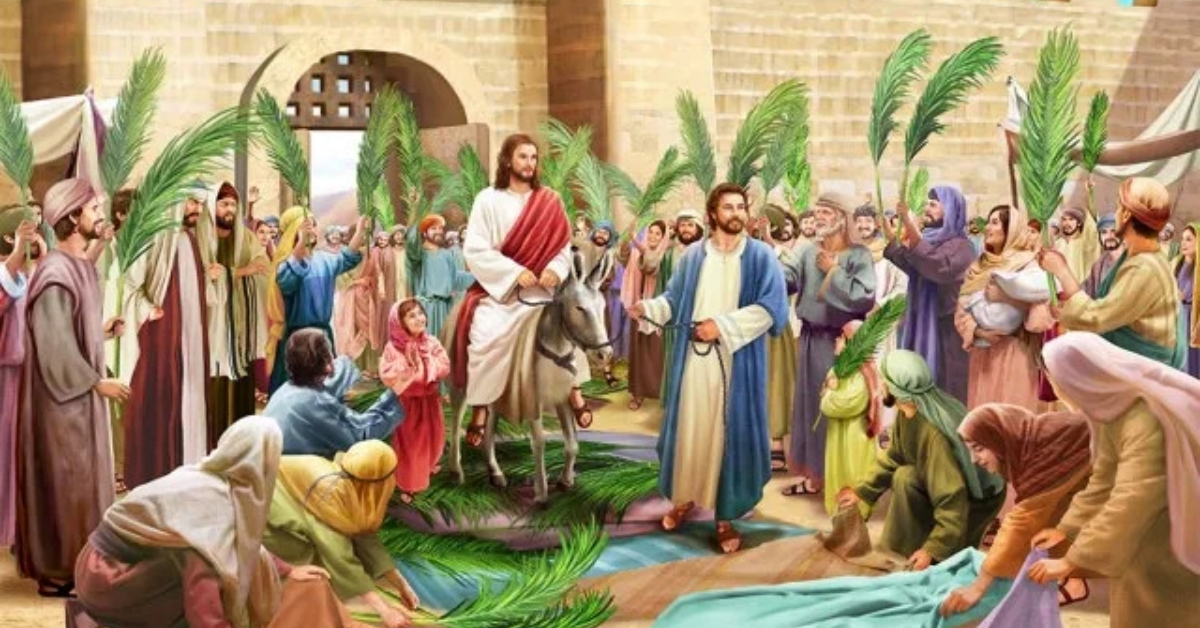
Picking the best airline or rental car is crucial for any travel venture. It is especially important when our trips involve impactful missions or crucial meetings. But on his most important journey, Jesus chose the a humble mode of transportion: a donkey.

Mark 11:1-3: “And said to them, “Go into the village in front of you, and immediately as you enter it you will find a colt tied, on which no one has ever sat. Untie it and bring it. If anyone says to you, ‘Why are you doing this?’ say, ‘The Lord has need of it..”

Lord Needs It
Jesus sends two disciples to get him a colt to ride into Jerusalem. Interestingly, this is the only time the words “The Lord has need of it” is mentioned in the Bible. God, all-powerful and lacking nothing, at times invites us to join Him in performing miracles. Similar to the boy sharing his lunch with Jesus, or the people whom Jesus asked to take away the stone from Lazarus’ tomb, God may involve us in these moments.

Reason for the Donkey Ride
So why did Jesus choose a donkey? Let’s explore some of the reasons:

  • Perfector of Past Prophecy: About 500 years prior to this event, Zechariah had prophecied this: “Behold, your king is coming to you; righteous and having salvation is he, humble and mounted on a donkey, on a colt, the foal of a donkey.” (Zechariah 9:9).
  • Perfect Servant: Gospel of Mark portrays Jesus as the Suffering Servant. Jesus rides a borrowed donkey, similar to Him borrowing Peter’s boat for preaching, and later borrowing Joseph of Arimathea’s tomb for burial. He chose the donkey to emphasize that he connects with the poor and oppressed. What a humble Savior we have!
  • Perfect Peacemaker: In the Old Testament, kings used to arrive on donkeys in order to signify that they come in peace. Horses were used in wars, and as decorated animals to signify a victory in a war. So this lowly donkey was indeed the right choice for the Master who came to give us peace with God!
  • Perfector of Future Prophecy: Jesus came on a donkey in his first coming because it wasn’t yet time to come on a horse. Revelation Chapter 19 shows Jesus riding triumphantly on a white horse.

Unqualified Yet Untied
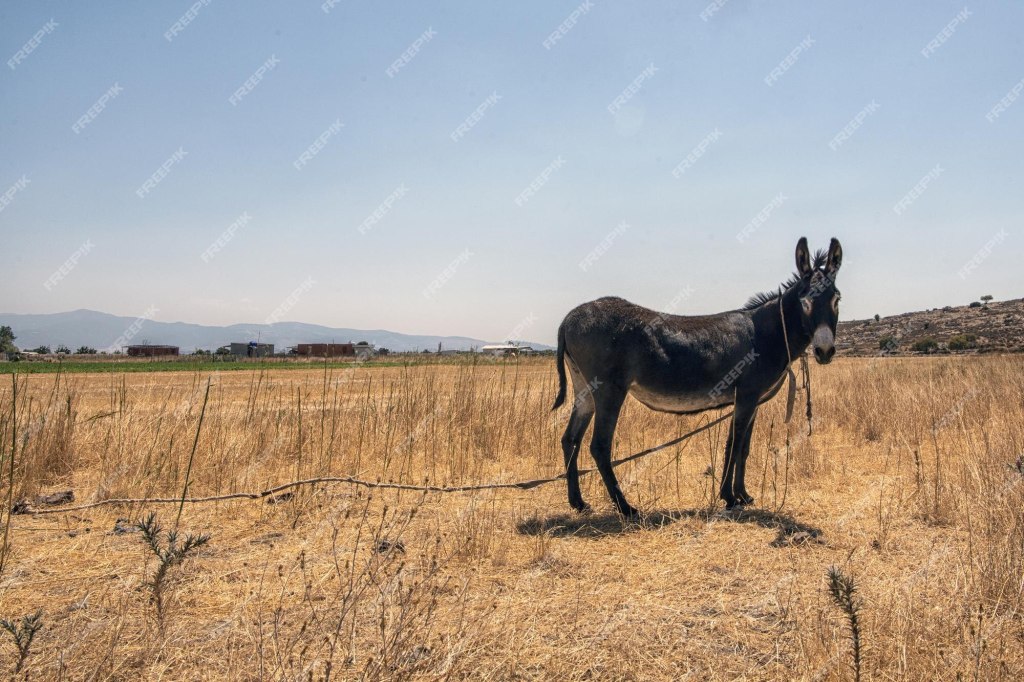
This donkey would be the least likely choice if Jesus tasked his disciples with finding the best one for him to ride. Training a new colt to ride is a long process. This colt did not have the training or experience that was needed to carry the King of Kings into a Triumphant entry. Moreover, it wasn’t in the same village, making it unlikely to be discovered. But the Master knew exactly which animal he has chosen and his instructions was : Untie him!

Glory to God Alone
This humble donkey, whose name, town, and owners remain unknown, received no recognition for its work. When chosen by God for a task, we should ensure all glory goes to Him.

Life Application
If Jesus used this lowly animal to carry Him, He certainly can use you! If the enemy convinced you that you are indeed an inferior, remember that the Master knew the one that was inexperienced, outside and tied up!
1 Corinthians 1:27 says: “But God chose what is foolish in the world to shame the wise; God chose what is weak in the world to shame the strong;” His Word is everlasting and His promises are unchanging. So, you too can have hope, if you choose to trust Him and make yourselves available for Him!

Leave a comment

Powerful Pain Relief

Products that promise to alleviate pain and discomfort are everywhere. From headache pills to post-surgery relief, hundreds of companies promise to make the pain vanish. In the Bible we see a woman who found pain relief without any of these products: Hannah.

1 Samuel 1:10-11 – She was deeply distressed and prayed to the Lord and wept bitterly. And she vowed a vow and said, “O Lord of hosts, if you will indeed look on the affliction of your servant and … but will give to your servant a son, then I will give him to the Lord all the days of his life.

Preview into Hannah’s Pain
In Biblical times, barrenness was seen as a divine curse, especially for women who bore the stigma of childlessness. Ridicule and mockery were commonplace. Without modern medical treatments, the lives of barren women were often marked by sorrow and depression.

Prayers Amidst Peril
Finding time for prayer in the midst of perilous times can feel like an extraordinary challenge. Despite the reassuring biblical promise that the Lord is near to the broken-hearted, we often find ourselves falling for the enemy’s tactics of distraction, disappointment, and detours.

Process of Prayer
We can learn a few lessons from Hannah’s prayer:

  • Prayer & Petition: Verse 9 says : “..And she was in bitterness of soul and prayed to the Lord and wept in anguish.” While everyone else is enjoying the annual temple festivals, with friends, food, and lots of children, Hannah found a quiet place to pour her heart to the Lord.
  • Praise Precedes Problems: And then she made a vow and said, “Lord of Hosts, if You will…” Did you know that Hannah is the first one to call God the “Lord of Hosts” (Jehovah Saboath)? In the past, God revealed Himself through various names, but it was a woman in the depths of despair who bestowed upon Him this famous title! She decided to proclaim God’s greatness before her problems.
  • Promises to God: Hannah’s prayers and vows are specific. Essentially she is asking the Lord for a son, so that she can dedicate him for the Lord.
  • Persevering in Prayer: Hannah’s prayer was not a one-time instant coffee type of prayer. Verse 12 says she kept on praying with quivering lips, and pouring her whole sorrow to the Lord. Too often, we settle for quick-fix prayers and blame God’s will when answers don’t come swiftly.
  • Persuaded in Prayer: Verse 18 says: “Then the woman went her way and ate, and her face was no longer sad.” While her enemies still taunted her, and nothing had changed immediately, she was fully persuaded that God has answered her prayers.
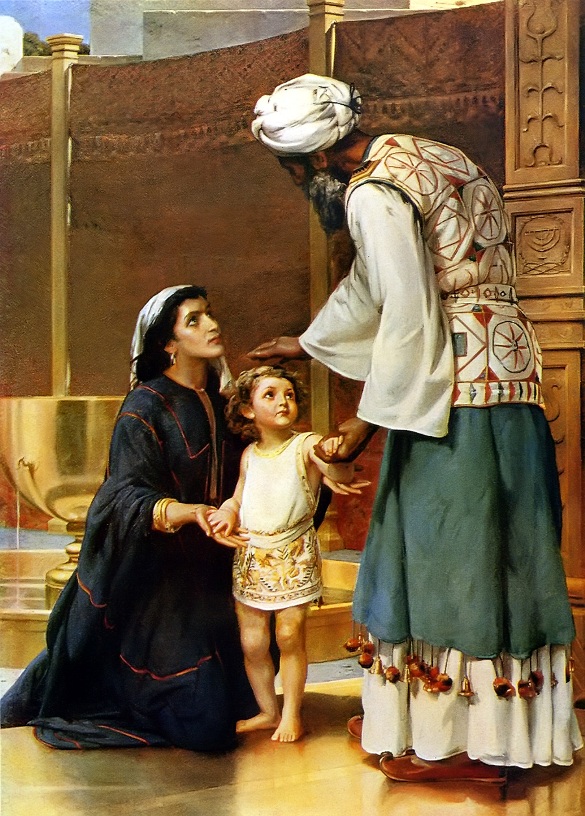
Samuel Dedicated by Hannah at the Temple by Frank W.W. Topham

Promised son, Perfect Prophet
In due time, Hannah’s son, prophet Samuel was born. Verse 11 says: “For this child I prayed, and the LORD has granted me my petition which I asked of Him.” In unwavering devotion, Hannah fulfilled her vows to the Lord, and in divine faithfulness, God blessed her with an additional five children! (1 Samuel 2:21)

Personal story
For those who know us, this story resonates with our family’s experiences. Through seven years of fervent prayers and many years of medical tests, the physical toll was immense. Yet, our sole source of hope and solace was the unwavering presence of the Lord. In due time, He graciously answered our prayers, blessing us with three precious children.

Life Application
As you navigate through life, sometimes things won’t work out as per our imaginations. God still has a plan for your pain. Trust Him knowing that as His child, He is with you in your problems. Isaiah 63:9 says: In all their distress, He too was afflicted, and the Angel of His Presence saved them. Remember that though Hannah wanted a child, God wanted to give her a prophet. So keep persevering in prayer, God will surely answer you in ways you cannot imagine.

Spanish version: https://dewdropsofmanna.com/spanish-pages-list/potente-alivio-del-dolor/

Hindi version: https://dewdropsofmanna.com/hindi-pages-list/शक्तिशाली-दर्द-निवारक/

Tiny Coins, Timeless Impact

Coin collection is a hobby that people have enjoyed for many centuries. Collectors spend hundreds of dollars in the process of acquiring the rarest, most unique coins. But did you know that there was a set of coins in an offering basket that caught heaven’s attention?

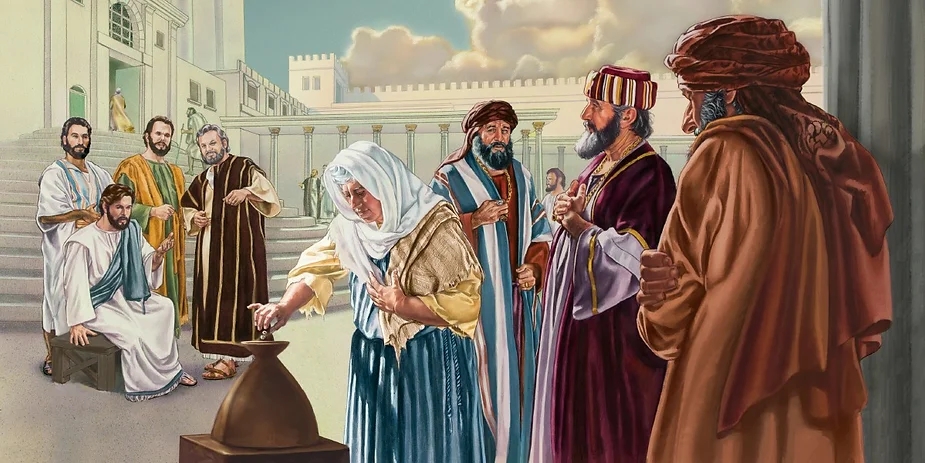
Mark 12:42-44 – But a poor widow came and put in two very small copper coins, worth only a few cents. Calling his disciples to him, Jesus said, “Truly I tell you, this poor widow has put more into the treasury than all the others. They all gave out of their wealth; but she, out of her poverty, put in everything—all she had to live on.

Window into Widows Life
In ancient Israel, widows faced neglect and mistreatment and had no one to plead their case. Acts 6 recounts discrimination against a group of widows during food distribution. Yet, the Bible imparts valuable lessons through widows’ lives, revealing God’s heart through humble members of society.


Clinking of the Coins
In the temple courtyard, there were 13 trumpet-shaped collection chambers, each designated for different offerings. Seated opposite these receptacles, Jesus keenly observes the varied ways in which people contribute. People joyfully dropped money into the thirteen boxes, relishing the rhythmic cascading sound of coins, often attracting positive attention and approving glances of others.


Mighty Mites
Verse 42 says: “Then one poor widow came and threw in two mites.” A mite is the smallest denomination in Jewish currency, worth only one-eighth of a cent. Though her quarter cent offering was practically worthless in human eyes, this poor woman’s offering caught the eyes of the Master! Contrary to our inclination to applaud famous givers, heaven recognizes the profound sacrifice made by a humble widow with her two small coins.

Portion versus Proportion
The widow’s offering held special significance as she gave everything she had. Although the portion of her monetary contribution might not have surpassed others, Jesus acknowledged it as MORE because of the depth of her sacrifice. While others gave without sacrifice, she offered her all, making her portion proportionally greater in the eyes of the Lord.

More than Money
Beyond finances, this principle extends to every aspect of our service to the Lord. Key lessons from this widow include:

  • Faith: Facing an uncertain future without any other tangible support, and risking her livelihood, this woman placed unwavering faith in God. She trusted in His ability to supple her needs. Perhaps inspired by the biblical account of the widow of Zarephath (1 Kings 17:7-16), her act of giving became a testament to her steadfast belief in God’s providence.
  • Sacrifice: Giving when you have very little is a daunting task, yet this woman did not withhold her last two copper coins from the Lord. Her sacrificial act mirrors God’s ultimate sacrifice for us: Jesus. God values offerings that involve true sacrifice, a principle King David understood very well.
    In 1 Chronicles 21:24 King David insists on buying the plot for sacrifice for full price. He declares that he will not offer burnt offerings that come without a cost or sacrifice on his part.

Personal Story
While personal stories aren’t a regular feature in my blogs, this passage stirred memories of my maternal grandmother from the land of Kerala, India. Widowed at 45, she, a single mother of six, placed her trust in the Lord. Despite limited resources, she selflessly shared food with those in need, sometimes leaving her own children hungry. The Lord took note of this, blessing her with the opportunity for all her children to come to America. She lived in this land for over 27 years, witnessing the goodness of the Lord to her children and grandchildren until she passed away at the age of 93.

Life Application
Let us never underestimate the offering, whether it’s our finances, services, talents, or worship. Embrace the call to wholeheartedly give to the Lord. Understand that He sees the sincerity in your sacrifice despite any perceived limitations or weaknesses on our part. Hebrews 6:10 says: God is not unjust; he will not forget your work and the love you have shown him as you have helped his people and continue to help them.
So, let’s make a decision that we will sacrificially give Him our time, our resources, and our wealth. He is a God who is faithful to His Word.

You Are Loved!

As February arrives, displays of love saturates our world, with heart-shaped displays and the fragrance of many roses. From sweet chocolates to dreamy trips, expressions of love are plentiful. What does true love look like, and how long does it last? Let’s explore:

Jeremiah 31:3 – The Lord has appeared of old to me, saying: “Yes, I have loved you with an everlasting love; therefore, with lovingkindness I have drawn you.”

Love and Hope for the Hopeless
Jeremiah Chapter 31 depicts hope amid despair, narrating the struggles of Israel and Judah who faced consequences for their sins. The magnitude of their sins, and the subsequent punishments, has caused pain, sorrow and suffering. Yet, within this relentless cycle, a refreshing reminder emerges, reminding them of the promises of the Lord from the past. In times of despair, just one appearance of God, or just one word from Him, can give us hope.

Corrected in Love
In moments of corrective discipline, it may be challenging to grasp that it stems from God’s profound love for us. Here the Lord is reminding Israel that though they’ve failed Him, He still loves them. King David’s life is a classic example of how God lovingly corrects someone who has strayed away. Even in God’s corrections, remember that He never withdraws His love from you.

Love Without Limits
We often hope that every human love is everlasting, yet even the most exemplary love is inherently temporal. In contrast, consider two important characteristics of God’s love:

  • Beyond Time: God’s love transcends time, and it is not bound by time or calendar restrictions. One verse that summarizes that is Deuteronomy 7:9 which says: “Know therefore that the Lord your God is God, the faithful God who keeps covenant and steadfast love with those who love him and keep his commandments, to a thousand generations.
  • Beyond Measure: Psalm 36:5 says Your mercy, O LORD, is in the heavens; Your faithfulness reaches to the clouds. While human love is limited on how much it is reciprocated, God’s love is poured without measure.
Photo by Alejandro Avila on Pexels.com

Attracted By Love
Jeremiah 31:3 ends with: Therefore, with lovingkindness I have drawn you.
In our world, countless tales resonate of individuals falling in love, captivated by the attraction to each other. God draws us to him with his utmost expression of love: Jesus.


Cost of Love
We tend to gauge how much people love us based on how much their gifts cost. In order to love us, God gave His only begotten Son Jesus, who emptied Himself of all His heavenly glory, and came down to die a gruesome death. That my friend, is the ultimate expression of love! No other love surpasses the divine love manifested in Jesus Christ

Life Application
As you gaze upon love’s many expressions around you, let Jesus be the ultimate beacon of love. Perhaps it’s loneliness, rejection, or life’s storms that have weighed you down. For some others it could be the negative health reports , or failures in life, that has left you depressed and exhausted. But rest assured that the unending love of God and his unchanging Hands are embracing you always!
Isaiah 53:3 points us to Jesus and calls Him “a man of sorrows, and familiar with suffering.” So, whatever you are going through, be assured that He’s been there, He knows, and He cares! So take heart and cheer up knowing that you are always loved!

Spanish version: https://dewdropsofmanna.com/spanish-pages-list/eres-amado/
Hindi version: https://dewdropsofmanna.com/hindi-pages-list/अचछ-उपहर/

Making Way For Miracles

In our fast-paced world filled with technology like cars, smartphones, and computers, we all want everything to be quick. While exploring biblical miracles, it becomes apparent that not everything has an instant solution. Let’s look at one example of a man named Elijah and the steps he took that led to a miracle.

1 Kings 18:31-33 (NKJV): Elijah took twelve stones, one for each of the tribes descended from Jacob … With the stones he built an altar in the name of the Lord, and he dug a trench around it…  He arranged the wood, cut the bull into pieces and laid it on the wood.

Rebuild before Revival
Elijah knew that in order to activate the miracle, rebuilding the altar is a significant first step. This altar was in ruins as Israel embraced pagan cultures, forgetting the God of their forefathers and the covenant. Elijah knew of how the patriarchs before him had constructed altars in worship. One example is seen in Exodus 24, when God renews His covenant with Israel on Mount Sinai. Moses builds an altar with twelve stone pillars, symbolizing the tribes. Young Israelite men offer burnt and fellowship offerings as directed. The glory of God came down upon the mountain.

Water the Altar
1 Kings 18:33-35- Then he said to them, “Fill four large jars with water and pour it on the offering and on the wood.” Do it again,” he said, and they did it again. “Do it a third time,” he ordered, and they did it the third time. The water ran down around the altar and even filled the trench.

In a drought season, when water is priceless, Elijah surprisingly directs the pouring of 12 jars onto the altar. We see some important principles here:

  • Clarity: Elijah sought to clearly underscore that YAHWEH God alone would provide the answer, setting it apart from the priests of Baal known for deceptive practices, such as creating artificial fire.
  • Faith: Water on the altar was a sign to the people that Elijah firmly believed that YAHWEH God will do His miracle. It also was to show that no matter how impossible it is for fire to burn on wet wood, God will certainly be able to do it.

Thirty Seconds of Prayer
After setting the scene with the altar, and preparing the sacrifice, Elijah prays a short 63 words prayer:
“Lord, the God of Abraham, Isaac and Israel, let it be known today that you are God in Israel and that I am your servant and have done all these things at your command. Answer me, Lord, answer me, so these people will know that you, Lord, are God, and that you are turning their hearts back again.”

Bible scholars say that this prayer took just 30 seconds. Contrast this to how the prophets of Baal shouted and entreated their god all morning long.

Answer to prayer
1 Kings 18:38 shows the result of this prayer: Then the fire of the Lord fell and burned up the sacrifice, the wood, the stones and the soil, and also licked up the water in the trench. Now when all the people saw it, they fell on their faces; and they said, “The Lord, He is God! The Lord, He is God!”

Life Application
Have we been seeking the Lord to do some miracles for us? If so let’s examine and rebuild any broken altars. Have we replaced our altars of worship in our homes with altars of technology and comfortable living? Perhaps over the years, unbeknownest to us, the enemy has replaced the altars dedicated to prayer life and holy living, with broken altars. Let us go back to the basics mentioned in the Bible. If we align ourselves to His Word, He is faithful to meet you in the point of your need. 2nd Chronicles 16:9 says: For the eyes of the LORD run to and fro throughout the whole earth, to show Himself strong on behalf of those whose heart is loyal to Him.

On the other hand, are you encountering seemingly impossible situations, like wet wood resisting a fire on the altar? Take heart, for just as Elijah trusted God and witnessed His miraculous flame, your challenges can be transformed by just one divine touch. Trust in the Lord who turns impossibilities into the extraordinary. He is a God who is faithful through all generations.

Spanish version: https://dewdropsofmanna.com/spanish-pages-list/abriendo-paso-a-los-milagros/

Hindi version: https://dewdropsofmanna.com/hindi-pages-list/चमत्कारों-के-लिए-रास्ता-ब/

Christ Feet, Her Seat

In a world buzzing with distractions, concentrating on one thing often becomes difficult. Multi-tasking and simultaneously handling many responsibilities have now become the norm of life. But the Bible talks about one woman who chose the right thing in the midst of life’s demands: Mary of Bethany (sister of Martha).

Luke 10:39-40: And she had a sister called Mary, who also sat at Jesus’ feet and heard His word. But Martha was distracted with much serving, and … said, “Lord, do You not care that my sister has left me to serve alone? … tell her to help me.”


Distracted and Drawn Away
In a culture where women traditionally prepared meals for guests, Martha’s plea for help was reasonable. However, the Bible clearly identifies the underlying problem: distraction. The Greek word for distraction is “periespato” which means “to be drawn away.” Though she initially welcomed Jesus into the house, her mind was eventually distracted and drawn away. Martha’s heart was lost in the baking of bread, while the Bread of Life himself was speaking with them!

Steadily At His Feet
Mary is consistently found at Jesus’ feet on three different occasions in the Gospels. In this quiet moment at her house, amidst grief over Lazarus’ death (John 11:32), or in an act of worship (John 12:3), she is consistently found at His feet.
Sitting at the feet of a teacher symbolized profound respect from the student to the teacher. Some things to note from Mary’s life:

Boldness: It is important to note that it was always men who were called by Rabbis for the role of a student. Women did not enjoy this privilege. But Mary took a bold step of taking the student posture because she recognized that she had Jesus the Messiah in her house and she wasn’t going to let norms, culture, or anything get in the way of having an encounter with Him.

  • Focus: “Mary sat and heard His word.” The Greek word for heard is akouō which is used to describe hearing, understanding and responding. Mary was so focused on what the Master was saying that she chose to ignore every other thing that was demanding her attention.

Only One Thing
Luke 10:42: “But one thing is needed, and Mary has chosen that good part, which will not be taken away from her.”
Jesus did not address Martha’s request to get Mary to help her. Rather he focused her distracted heart. So what is that one thing that Mary chose? She chose give the Lord her whole heart, and prioritized nothing else over Him.
In Psalm 27 we see David is talking about an army coming against him, but his one desire is stated in verse 4: “One thing have I asked of the LORD … that I may dwell in the house of the LORD … to gaze upon the beauty of the LORD.”

Life Application
In the midst of life’s demands, choose to give God primary focus, pushing away distractions. These days we too get drawn away by gadgets and material affluence. Let us start with the first step of kneeling in prayer. As we read the Bible, let us pause and think what the Lord wants to illuminate in our hearts. Like Mary, let us choose that one good thing: the Presence of God, and give Him the one and only thing He wants from us: our heart.